
A lot of science fiction, and certainly mine, happens on planets somewhere out in the universe so they can be tailored to the author’s requirements for the story. Planets that aren’t even real planets. So I thought it was time I wrote about our own solar system. This post is an overview, with each planet to follow in future posts.
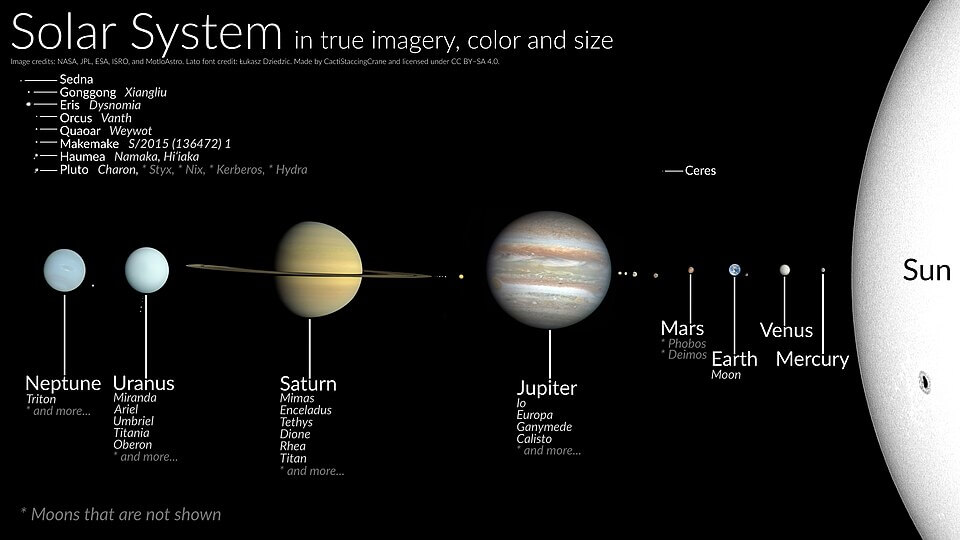 The term ‘solar system’ is used to refer to the space around our star, the sun, and the planets and other things orbiting around it. The main things of course are the eight planets: Mercury, Venus, Earth and Mars (terrestrial planets), then Jupiter and Saturn (gas giants), then Uranus and Neptune (ice giants). According to Wikipedia, if you added up the mass of everything in the solar system, the sun would account for 99.86% of that mass. If you exclude the sun, Jupiter and Saturn take up nearly 90% of the rest.
Beyond Mars is the frost zone where liquid surface water is impossible as the sun’s warmth doesn’t reach far enough. In addition there are dwarf planets and moons and comets and asteroids. The Solar System is constantly flooded by the charged plasma particles of the solar wind, interplanetary dust, gas and cosmic rays.
 Ann Marie Thomas is the author of five medieval history books, a surprisingly cheerful poetry collection about her 2010 stroke and two further poetry collections, and the science fiction series Flight of the Kestrel, of which there are four books are out now. Follow her at http://eepurl.com/bbOsyz and get free books.