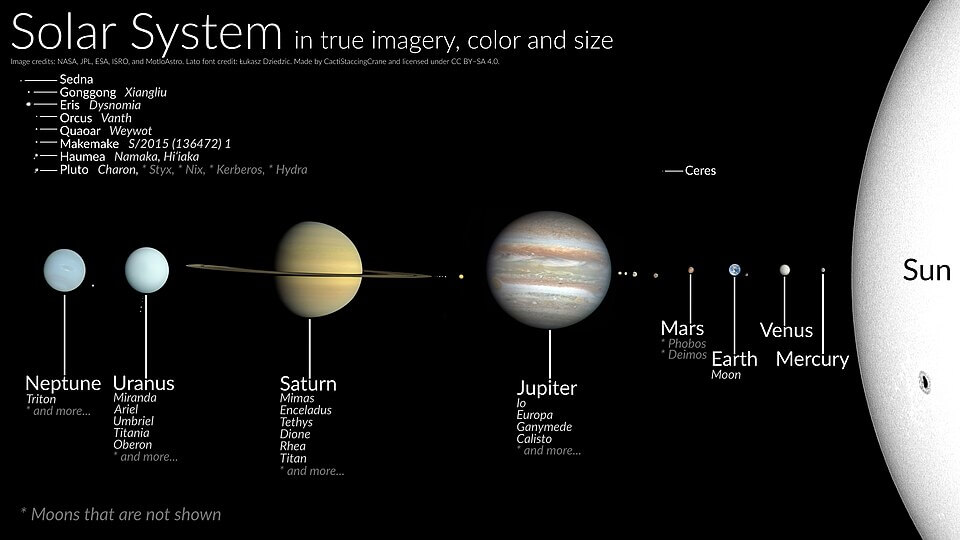
Information gathered from Wikipedia and NASA.
Mercury is the first planet from the sun and the smallest in the Solar System. It is only slightly larger than Earth’s Moon. It is a rocky planet with a trace atmosphere and a surface gravity slightly higher than that of Mars.
The surface of Mercury is similar to Earth’s Moon, being cratered. Its largest crater,
Caloris Planitia, has a diameter of 1,550 km (960 mi), which is about one-third the diameter of the planet (4,880 km or 3,030 mi). It always appears close to the Sun in Earth’s sky, either as a “morning star” or an “evening star”. It’s the fastest planet, zipping around the Sun every 88 Earth days. Mercury is named for the swiftest of the ancient Roman gods.
Mercury’s year is 88.0 Earth days but its day is 58.65 Earth days. Consequently, one solar day (sunrise to sunrise) on Mercury lasts for around 176 Earth days: twice the planet’s sidereal year. This means that one side of Mercury will remain in sunlight for one Mercurian year of 88 Earth days; while during the next orbit, that side will be in darkness all the time until the next sunrise after another 88 Earth days.
Above the planet’s surface is an extremely tenuous
exosphere and a faint magnetic field just strong enough to deflect
solar winds. Due to its very small
axial tilt, the planet’s poles are permanently shadowed, which strongly suggests that water ice could be present in the craters. Mercury consists of approximately 70% metallic and 30%
silicate material.
Mercury was heavily bombarded by comets and asteroids during and shortly following its formation 4.6 billion years ago, and received impacts over its entire surface during this period of intense crater formation, facilitated by the lack of any atmosphere to slow impactors down. The craters range in diameter from small bowl-shaped cavities to multi-ringed craters hundreds of kilometers across. During this time Mercury was volcanically active; basins were filled by magma, producing smooth plains similar to the maria found on the Moon.
The surface temperature of Mercury ranges from −173 to 427 °C (−280 to 800 °F).
Despite its small size and slow rotation, Mercury has a significant, and apparently global,
magnetic field. According to measurements taken by
Mariner 10, it is about 1.1% the strength of Earth’s.
The MESSENGER spacecraft is the first ever to orbit the planet Mercury, and the spacecraft’s seven scientific instruments, like the MASCS instrument used to create this colourful illustration of Mercury’s surface, are unravelling the history and evolution of the innermost planet. Credit: NASA/Johns Hopkins University Applied Physics Laboratory/Carnegie Institution of Washington
 Ann Marie Thomas is the author of five medieval history books, a surprisingly cheerful poetry collection about her 2010 stroke and two further poetry collections, and the science fiction series Flight of the Kestrel, of which there are four books are out now. Follow her at http://eepurl.com/bbOsyz and get free books.