The period of history that I concentrate on is the 13th and early 14th centuries. The very next thing that happened was the plague and its result was catastrophic.
The Black Death was a plague pandemic that occurred in Europe from 1346 to 1353. It was one of the most fatal pandemics in human history, leading to the death of up to 50 million people, around 30% to 60% of the European population and approximately 33% of the Middle Eastern population.
The Black Death was the second great natural disaster to strike Europe during the late Middle Ages (the first one being the Great Famine of 1315–1317).
Cause
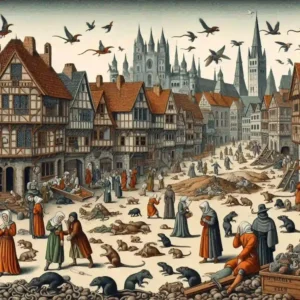
The medical knowledge at the time had no idea about the cause of the plague. It was attributed to unbalanced humors or that a conjunction of planets had caused “a great pestilence in the air”. Some Muslim doctors believed it was sent by God and nothing should be done to stop it. We know now it was spread by fleas on rats and other rodents fleeing climate change in Asia. The disease was caused by the
bacterium Yersinia pestis.The symptoms progressed through three stages:
Bubonic plague was the most common form. Symptoms appeared within two to eight days of a flea bite: fever, headache, chills, weakness, and painfully swollen lymph nodes called “buboes,” often in the groin, armpit, or neck. At advanced stages, these swollen nodes could rupture into open sores filled with pus. Left untreated, bubonic plague kills 30% to 60% of those infected.
Septicemic plague occurred when the bacteria entered the bloodstream directly. It caused fever, extreme weakness, abdominal pain, and shock. Skin and tissue, particularly on the fingers, toes, and nose, turned black and died. This blackening of the extremities likely contributed to the name “Black Death.” Untreated, this form kills anywhere from 30% to nearly 100% of patients.
Pneumonic plague attacked the lungs and was the most lethal variety. It developed rapidly, sometimes within 24 hours of exposure, bringing on fever, chest pain, coughing (often bloody), and shortness of breath. It was also the only form that spread person to person. Left untreated, pneumonic plague is always fatal and can kill within 18 to 24 hours of symptoms appearing.
The Black Death travelled along trade routes from Central Asia into Europe, arriving at Mediterranean ports in the late 1340s aboard merchant ships. A computer-assisted analysis estimated that England’s population dropped from 4.8 million in 1348 to 2.6 million by 1351, a decline of 46% in just three years. The population of Western Europe effectively halved in the span of a few years. And the plague didn’t strike once and disappear. It returned in waves for centuries, keeping populations suppressed well beyond the initial outbreak.
Economic and Social Aftermath

Here is how Science Insights described the results of the plague:
With half the population dead, the survivors found themselves in a transformed world. The most immediate change was a severe labor shortage. Peasants and workers who had been locked into feudal obligations suddenly had leverage: there were far fewer of them, and every lord needed hands to work the land. This dynamic is often credited with weakening feudalism and improving conditions for laborers, but the reality was more complicated.
In England, the government responded to rising wages by passing laws that attempted to freeze pay at pre-plague levels, triggering widespread resentment that contributed to the Peasants’ Revolt of 1381. In Italy, where economists have tracked real wages over time, the supposed “silver lining” for workers didn’t arrive until two or three generations after 1348. Elites pushed back against the compression of inequality, creating new forms of economic and social stratification even as old ones eroded.
The plague also shook religious institutions. The Church’s inability to protect the faithful or explain the catastrophe undermined its authority. Historians have credited the Black Death with helping to precipitate major cultural and economic shifts, including conditions that eventually fed into the Renaissance.
 Ann Marie Thomas is the author of five medieval history books, a surprisingly cheerful poetry collection about her 2010 stroke and two further poetry collections, and the science fiction series Flight of the Kestrel, of which there are four books are out now. Follow her at http://eepurl.com/bbOsyz and get free books.