As we explore the solar system, we reach the planet Venus. The second planet from the Sun, and Earth’s closest planetary neighbour, Venus is the third brightest object in the sky after the Sun and Moon. In history, it was called the morning star and the evening star, because sometimes it appears in the morning and sometimes in the evening. They didn’t realise the two were the same thing.
Here are some details from NASA:
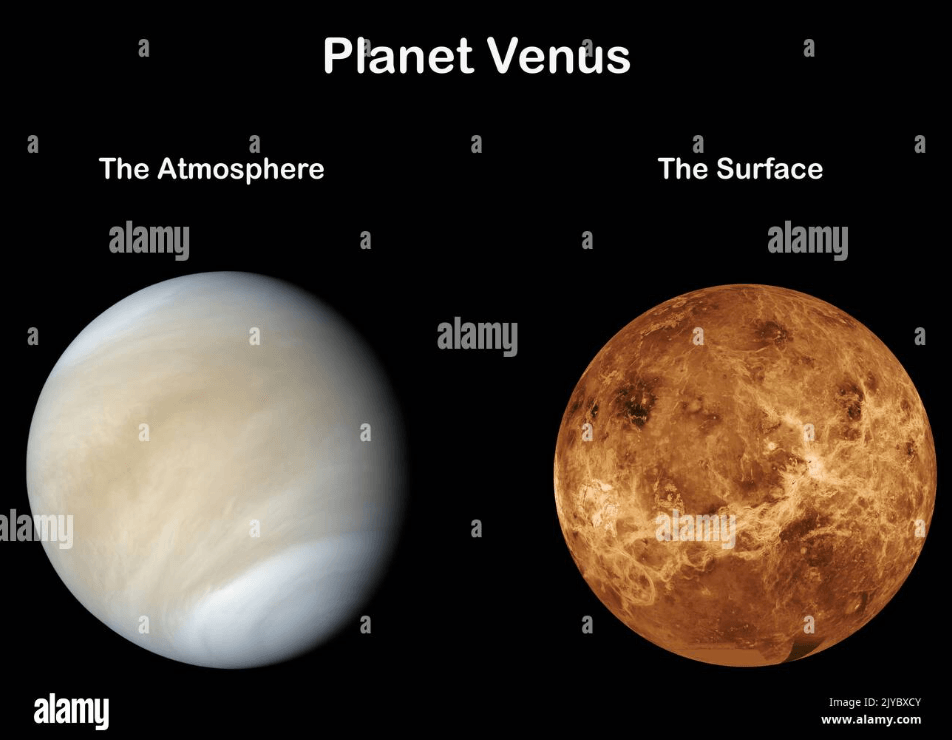 Venus is similar in structure and size to Earth, and is sometimes called Earth’s evil twin. Its thick atmosphere traps heat in a runaway greenhouse effect, making it the hottest planet in our solar system with surface temperatures hot enough to melt lead — about 872 degrees Fahrenheit (467 Celsius). And the atmospheric pressure at the surface is about 93 times what it is at sea level on Earth. Below Venus’ dense, persistent clouds, the surface has volcanoes and deformed mountains.
Topography
Wikipedia provides more details:
About 80% of the Venusian surface is covered by smooth, volcanic plains, consisting of 70% plains with wrinkle ridges and 10% smooth or lobate plains. Two highland “continents” make up the rest of its surface area, one lying in the planet’s northern hemisphere and the other just south of the equator. The northern continent is called Ishtar Terra after Ishtar, the Babylonian goddess of love, and is about the size of Australia. The Maxwell Montes mountain range lies on Ishtar Terra. The southern continent is called Aphrodite Terra, after the Greek mythological goddess of love, and is the larger of the two highland regions at roughly the size of South America. A network of fractures and faults covers much of this area.
Orbit and Rotation
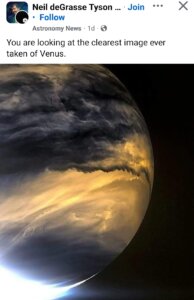 Venus spins slowly in the opposite direction from most planets. It spins so slowly that one Venusian day is longer than one Venusian year! Being closer to the Sun, the orbit of Venus is quicker than that of Earth, taking 255 Earth days. A Venusian day lasts 243 Earth days. Also, the Sun rises in the west and sets in the east, because of the reverse spin. Don’t ask me to figure out the calendar.
Because Earth is tilted on its axis, we get seasons: summer when our part of Earth is tilted towards the Sun, and winter when it’s tilted away. Earth’s tilt is 23 degrees from the vertical. Venus’s tilt is only 3 degrees, not enough to make a difference. Not that you would notice, because you would be squashed flat and boiled to death, that’s if you survived the sulphuric acid in the atmosphere!
 Ann Marie Thomas is the author of five medieval history books, a surprisingly cheerful poetry collection about her 2010 stroke and two further poetry collections, and the science fiction series Flight of the Kestrel, of which there are four books are out now. Follow her at http://eepurl.com/bbOsyz and get free books.